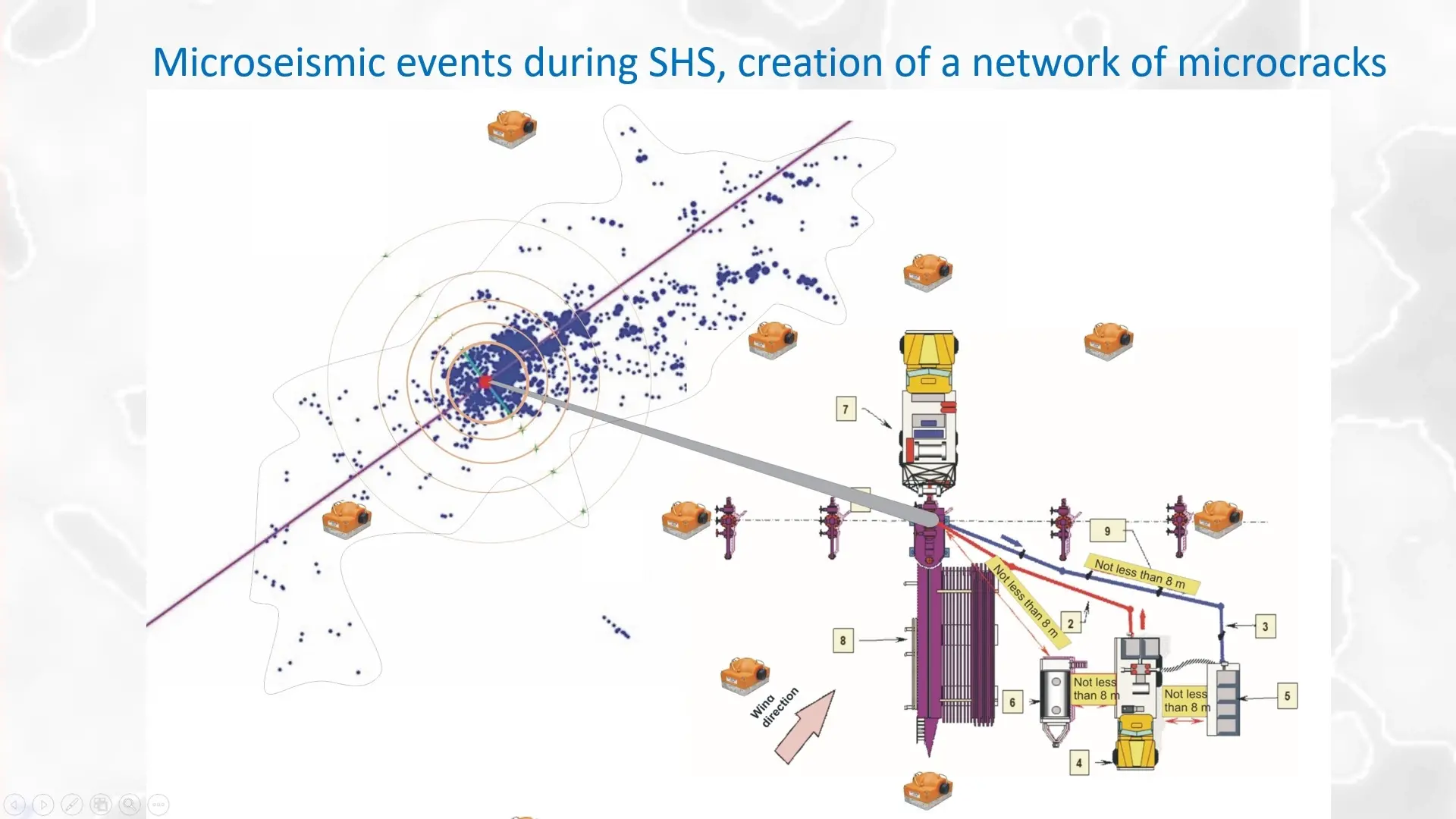
A Mobile Well Productivity Stimulation Unit (MUSS) is a unit for carrying out a set of works to
stimulate (increase) the productivity of production wells and oil recovery of a productive
formation, transport equipment, and maintain equipment in the field. MUSS is designed to control
the pressure in the well during the circulation of the process fluid (injection into the
reservoir) and the creation of seismic waves in the well by hydraulic shocks in order to destroy
blocking deposits in the bottom hole zone and restore permeability. In MUSS with an on-board
computer, on-line processing of data in the technological process and regulation of the pressure
and flow rate of the process fluid during the treatment of the bottomhole zone of the well are
carried out.
MUSS and Seismic Hydropercussion Stimulation of Wells (SHS).
Functions:
• Stimulates the bottomhole zone of production and injection wells with elastic waves and
pressure pulses with a frequency of 0.001-100 Hz (period of 600-0.01 s), amplitude of 2700 PSI
(up to minus 1500 PSI when using a jet pump)
• Provides a wedging effect in the pore-filtration channels of reservoir rocks
• Reduces the blocking effect of trapped phases - water, oil and gas, stable emulsions and mud
filtrate
• Increases fluid filtration between the well and reservoir rocks due to their decolmatization,
destruction of colloids and reduction of skin-factor
• Increases the depth of penetration of chemicals into low-permeable zones of reservoir rocks,
intensifies chemical reactions and accelerates the removal of their products
• Cleans the bottomhole zone of reservoir rocks, restores and increases hydrocarbon inflows and
well injectivity
Advantages of MUSS and Technology of Seismic Hydropercussion Stimulation of Wells (SHS).
• The use of a well stimulation method without Workover Rig
• Combination with Workover equipment, coiled tubing for any type of work (production test,
bottomhole treatment, acisizing, WSO, etc.)
• Application of software with machine learning algorithms Use of modern pressure sensors, sound
level meters, etc.
• Process control in automatic mode using artificial intelligence
• Cleans the bottomhole zone of reservoir rocks, restores and increases hydrocarbon inflows and
well injectivity
• The use of pulsed multiwave stimulation is aimed at increasing the oil recovery factor by 2-5%
due to the involvement of hard-to-recover residual reserves in drainage, increasing well
productivity by 50-70%
Main MUSS devices:
• Solenoid valve block (controlled valves).
• Power block with elements of regulation and control over voltage, strength and frequency of
alternating current, which provides electrical energy to all laboratory units. The power unit is
connected to an external electrical network or its own MUSS generator.
• Power supply unit for wellhead devices and ground panel with regulation and control elements
(rectifier, generator, current panel).
• Measuring circuit with control elements for well-head devices and the ground part of the
equipment, regulation and control of the measured parameters.
• Automatic recorder that provides recording of curves for monitoring the BHT technological
process.
• Control unit for pressure, acoustic signals (seismic signals), working fluid flow.
• A set of connecting wires with a winding device for connecting the laboratory with a block of
electromagnetic valves (controlled valves), equipment grounding.
• Measuring station with 2 - 8 channels of analog registration and 6 -16 - digital registration,
2-4 channels of TP control, power supply capacity up to 500 VA.
• Wellhead sensors and electromagnetic valves (controlled gate valves).
• Crane-manipulator for lifting during well stimulation.
Strengths:
• Flexibility due to the choice of any method of performing work: a well stimulation method
without well workover (rig) or a combination with workover equipment, coiled • tubing for any
type of work (bottomhole treatment, development, intervention, etc).
• Application of software with machine learning algorithms.
• Combination with other technologies: acid treatment, injection of surfactants, solvents, WSO,
flow diversion, geological and hydrodynamic modeling of oil and gas, etc.
• Experience in solving problems in the field of increasing well productivity and increasing oil
recovery.
Capabilities:
• Prospects for further promotion of oilfield equipment to the markets of foreign countries.
• Emphasis on increasing technologically sophisticated and more profitable equipment.
• An increase in the number of long-term contracts that can ensure the stability of cash flows
in the future, thereby improving opportunities for strategic planning of the development of
enhanced oil recovery technologies.



 Request via telegram